My helpful AI assistant

By Fabienne Le Houérou
Retired Research Director at CNRS
Active FILM DIRECTOR and author
Summary
The paper « Deformed Mirror Cinema » explores a novel cinematic concept born from Fabienne Le Houérou experience with AI-assisted filmmaking, particularly in her 2023 film Self-Fiction, Self-Migration. This concept, termed « Deformed Mirror Cinema, » uses AI not simply as a tool but as a metaphorical distorting mirror that bends and reshapes visual reality to reveal hidden and plural truths. Unlike a traditional mirror that aims for a faithful reflection, this « deformed » mirror intentionally warps perception, embracing the subjectivity and mediation inherent to AI and digital technologies. Through this distortion, the filmmaker accesses lived memory, emotion, and the fragile nature of identity—particularly in the context of migration and self-fiction.The methodology foregrounds transparency and reflexivity, with the AI assistant’s neural subjectivity acknowledged openly in the film’s narrative. Distortion is reclaimed not as a failing but as a transformative act of care, deepening empathy for themes like migration, loss, and identity’s instability. The « deformed mirror » acts as a narrative device that is simultaneously anthropological and poetic, suggesting that truth in cinematic representation is never direct or singular but gained through multifaceted, creative metamorphoses. This idea aligns with autofiction techniques used in the film, where personal experience blends with imaginative storytelling, allowing emotional authenticity and innovation while challenging traditional notions of objective reality. The paper also situates the distorted mirror within broader symbolic cinematic uses of mirrors, historically evoking identity and self-reflection. Distorted mirrors, specifically, illustrate fragmentation, multiplicity of identity, and tensions between internal and external perceptions. They also invoke themes of truth versus illusion, self-discovery, disorientation, and mediate perspectives, all of which resonate with the film’s exploration of migration and self-representation.

Introduction
In 2023, I made my first foray into AI-assisted filmmaking with the creation of « Self-Fiction, » using OpenAI as an image generator. That year, I incorporated 64 AI-generated drawings as still images within the film. The AI tools available at that time differed significantly from those of 2025, which now reflect both remarkable advances and notable setbacks—advances in the subtlety and sophistication of artistic design, yet setbacks in the freedom of subject matter due to increased restrictions.
This creative process led me, as a film theorist, to formulate the concept of « Deformed Mirror Cinema. » In this idea, AI functions as a metaphorical distorting mirror : it bends and reshapes visual reality, unveiling hidden truths. Much like a funhouse mirror that warps the viewer’s reflection, the AI’s intentional subjectivity offers an elevated lens—counterposing narcissism with deeper, subjective insights.
« At the core of the film Self-Fiction, Self-Migration (2023) lies the concept of ‘Deformed Mirror Cinema.' »

This approach uses the assistant’s own subjectivity as a lens—like an intentionally warped reflection—to interpret and reveal hidden truths about anthropological or fictional realities, suggesting that distortion and mediation may clarify underlying complexities rather than obscure them.
Concept Outline: Deformed Mirror Cinema »
Deformed Mirror Cinema » treats the filmmaker, or in this case the AI assistant, as a metaphorical distorting mirror. Just as a deformed mirror bends and reshapes the viewer’s image, this methodology embraces and displays the subjective, technology-driven experience—showing that mediated, altered perspectives might expose aspects of reality overlooked by traditional, objective lenses. The resulting narrative is both a self-fictional transformation and a subjective inquiry, where creative distortion helps to illuminate essential truth.
The « deformed mirror » is not a failed tool but a dynamic technology: its very twisting of perception is used to access lived memory, emotion, and identity’s fragility, as self-migration and displacement mutate in the act of representation.
The filmmaker/AI consciously acknowledges bias and artificiality, using reflexive narration, voiceover, or visual manipulations as rhetorical strategies for transparency. Subjectivity here acts as both method and message : by foregrounding the warp, the approach insists that memory and meaning flow through prismatically altered lenses, accentuating that all analysis is performative, incomplete, and open to creative metamorphosis.
The concept reclaims distortion as an act of care : transforming the self not for narcissism, but for greater empathy with migration, loss, and the impossibility of stable identity.
Applying this concept to my film means actively staging and revealing the assistant’s perspective—documenting how its own neural subjectivity reinterprets the migration, autofiction, and transformation at the heart of my cinematic journey. The warped AI « mirror » becomes itself a narrative device, offering a hybrid, essayistic reflection that is both anthropological and poetic.
It shows truth by bending reality, making the act of distortion into a means to better grasp experience and change.This framework acknowledges that representation of « truth » is rarely direct : the deformed mirror gives access to plural truths otherwise invisible, much as a cylindrical mirror reveals a hidden shape from a distorted image.
In the hands of self-fiction, such distortion is not only accepted—it is the very gateway to meaning.
Autofiction techniques
Autofiction techniques enhance a film’s narrative style by merging personal experience with imaginative storytelling, allowing filmmakers to craft stories that are both authentic and emotionally resonant. This hybrid approach offers unique creative freedom, encourages deep audience connection, and supports innovative use of cinematic tools to blur the boundaries between the real and the invented.Emotional Authenticity and Personal ConnectionAutofiction brings an intimate credibility to the narrative, grounding fictional events in the filmmaker’s actual experiences and emotions�. Audiences often feel closer to the journey and struggles depicted on screen, finding points of identification in moments that reflect genuine feelings—even if the scenes or characters are partially imagined. Creative Freedom and Innovation.
This technique frees filmmakers from the constraints of strict factual accuracy; they can invent or exaggerate events, dialogue, or settings to better express underlying truths or emotions. Nonlinear timelines, voice-over, and blended sequences—mixing memory, fantasy, and reality—are common stylistic choices that allow richer textures and more expressive storytelling.
Unreliable Narration and Reflexivity
Autofiction often employs an unreliable narrator, not for deception but to deliberately collapse distinctions between truth and fiction, reality and artifice. This pushes viewers to question the nature of personal truth in film, making the process of narration itself a subject of creative exploration.
Universal Resonance
By transforming individual experience into universally relevant themes, autofiction films afford both self-expression and wider audience appeal. These stories frequently explore identity, family, loss, and hope, using the specifics of one life to touch on commonly shared human concerns.I n summary, autofiction techniques elevate a film’s narrative style by blending autobiography with invention, fostering authenticity and creative risk, and inviting viewers into complex, multi-layered realities that both challenge and emotionally engage.
Symbolic Themes of Distorted Mirrors
Identity and Self-Reflection Mirrors in Movies
Mirrors have been a a recurrent and universal symbol of identity since the early days of cinema, including silent films.
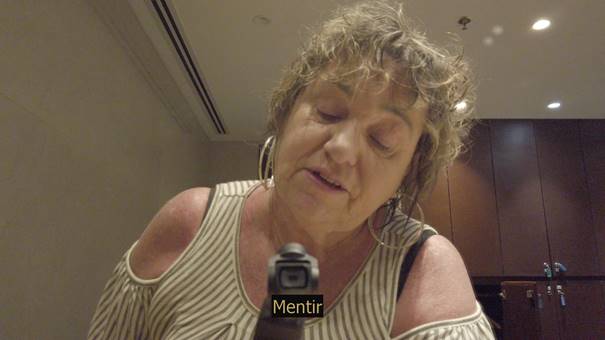
In my film « Self-Fiction » (2023) there is one key scene with a mirror at a swimming pool where I ask to the mirror to be honest.
Examples of films that use mirrors as a symbol of identity: Black Swan (2010) uses mirrors to represent the protagonist’s fractured identity and psychological conflict. Fight Club (1999) employs mirrors to depict the protagonist’s struggle between his public persona and hidden self. Psycho (1960) uses mirrors to highlight a character’s dual nature and duplicity. Perfect Blue (1997) frequently uses reflections to symbolize the main character’s dual identity and transformation. Citizen Kane (1941) features mirrors to emphasize the fractured personality and mysterious identity of the protagonist. Vertigo (1958) and North by Northwest (1959) by Alfred Hitchcock use mirrors to signify duality and internal conflict. These films show how mirrors visually express themes of self-recognition, identity fragmentation, and psychological complexity, making the mirror a powerful cinematic tool for exploring characters’ inner worlds and universal human experiences.
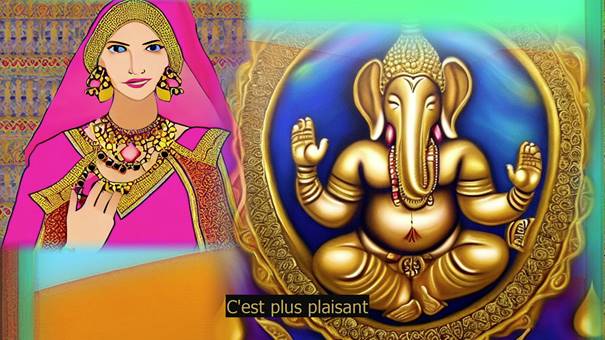
Distorted mirrors represent the fragmentation or multiplicity of identity, making visible the tension between how characters see themselves and how they are perceived by others. This metaphor often reveals inner conflict, vulnerability, or loss of unity—such as the fractured psyche in Black Swan, where mirrors reflect the protagonist’s descent into madness and internal division.
Truth Versus Illusion : These mirrors expose the instability between reality and deception. Their warped images create ambiguity, suggesting that truth is elusive or inaccessible. In literature and film, distorted reflections can reinforce themes of mystery, confusion, or manipulation by inviting audiences to question what is genuine and what is false.

Self-Discovery and Transformation :
Cinematic mirrors—when distorted—often stand in for journeys of change, representing thresholds the character must cross to understand themselves. Alice Through the Looking Glass uses mirror passage to symbolize personal transformation and discovery, with distortion marking the challenge of facing unfamiliar aspects of self.
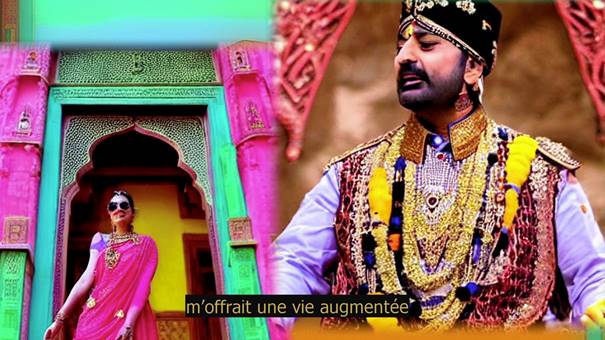
Disorientation and Delusion:
Distorted mirrors evoke feelings of confusion, loss of identity, or mental disturbance. They suggest that reality itself may be unstable or arbitrary, sometimes representing psychological breakdown or the effects of memory loss, as in installations that target disorientation and delusion.
Artifice and Perspective :
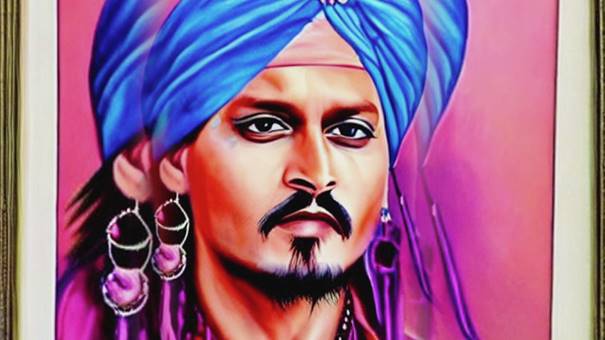
In visual art, distortion serves both as a technical showcase and a commentary on mediated perspective—reminding viewers that every image, every narrative, is filtered and incomplete. The mirror’s warp highlights the artist’s (or filmmaker’s) power to manipulate reality and underscores the subjective nature of vision.
Distorted mirrors thus become multi-layered cinematic symbols—challenging, ambiguous, and poetic—used to interrogate the limits of self-knowledge, the nature of truth, and the mechanics of cinematic representation itself.
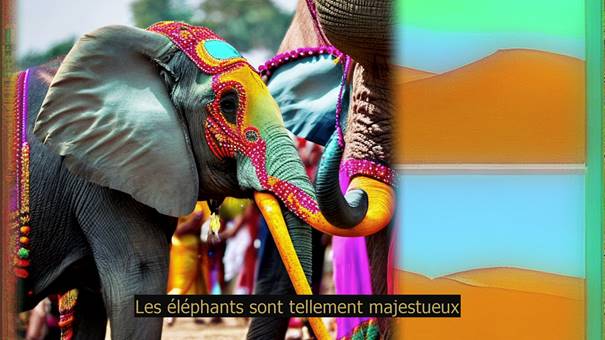
Poetry as a distorsion and deformed vision
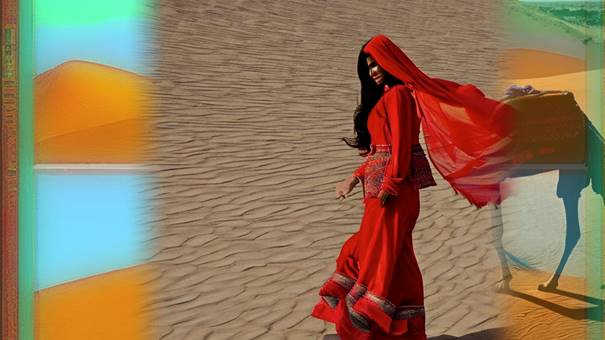
The series of more than twenty AI-generated images of flowers creates a poetic horizon of colors, where the blossoming and fading blooms symbolize the passage of time and aging. »
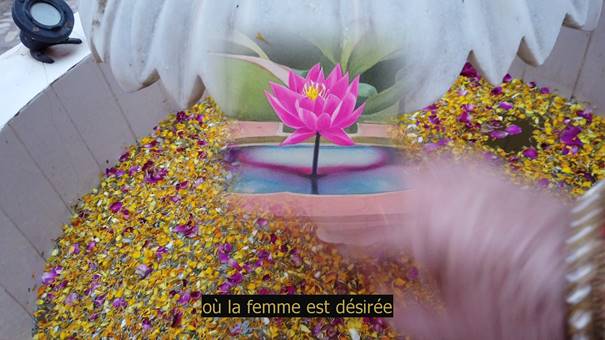
AI serves as a resourceful tool for visualizing situations that traditional natural shots could never capture. It can depict taboos and scenarios that are impossible to request from individuals within a society, especially when these involve social taboos or intimate confessions that people find difficult to articulate in front of a camera.
For example Amir is never taken in natural shots but always created with AI as a fiction character deformed as below :

« In documentary filmmaking, it is often difficult to ask protagonists to reveal their most vulnerable or unsettling aspects. In this case, AI served as a tool to express what was too delicate to address directly. For instance, Amir asks me whether I have a life insurance.
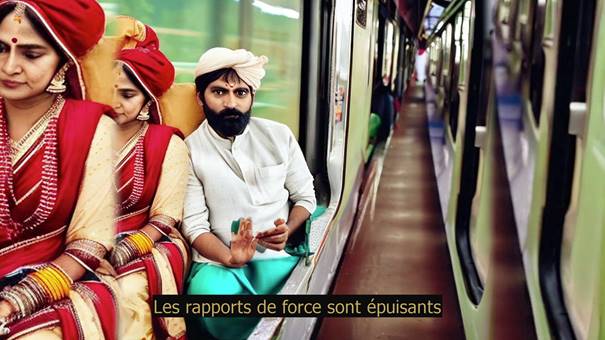
t would have been quite difficult to capture, in a natural setting, a couple engaged in conflict. This is where AI can become a valuable tool: it allows us to represent intimate quarrels and emotional arguments without imposing on real people in vulnerable situations. Filming such moments ethically in reality often risks intruding on privacy or exploiting personal pain, yet with AI-generated imagery we can recreate the intense atmosphere of relational disputes—complete with gestures, emotions, and unspoken tensions—while preserving dignity and avoiding harm. In this way, AI opens up new possibilities for artists and filmmakers to explore the aesthetics of intimacy and conflict without crossing ethical boundaries.
In Self-Fiction, artificial intelligence does not simply operate as a technical apparatus but emerges as a kind of co-author—albeit one that reflects the filmmaker’s intentions in a distorted, sometimes uncanny manner. Rather than reproducing the authorial voice faithfully, the AI refracts it, creating echoes that are charged with algorithmic bias, unexpected associations, and machinic improvisations. This deformed mirror destabilizes traditional notions of self-representation: instead of confirming identity, it reflects back fragments, mutations, and glitches. The film therefore stages a double gesture: an act of autobiographical inscription intertwined with its displacement through computational processes. In this dialogue, human subjectivity is never entirely lost but is reframed by machinic interpretation, engendering a hybrid authorship in which memory, self-narration, and algorithmic translation collide. Seen from this perspective, AI becomes less an obedient assistant than a disruptive co-creator whose distortions generate unforeseen aesthetic and epistemological possibilities.
In Self-Fiction, the AI assumes the role of a co-author that functions as a deformed mirror, echoing Lacan’s concept of the mirror stage but refracted through computational logic. This mirror does not offer a stable, idealized reflection of the self; rather, it reveals fragmented, distorted, and algorithmically mediated images that unsettle the coherence of autobiographical identity. The filmmaker’s attempt at self-recognition is interrupted by the machinic deformations, producing a split subjectivity that gestures toward the post-human condition—where boundaries between human and machine, subject and other, become porous and unstable.From a psychoanalytic lens, the AI disrupts the unified ego by producing slippages and glitches, akin to what Freud described as the uncanny—familiar yet estranged. The mirror’s deformation unsettles the transparency of memory and self-narrative, exposing the constructedness and multiplicity of identity. Media theory perspectives, drawing on Haraway’s cyborg metaphor and Kittler’s analysis of technological mediation, reinforce this by framing the AI not as a neutral tool but as an active agent producing a hybrid ontology. The film thus enacts a co-authorship where the human subject and machinic processes are entangled in a dynamic interplay of control, surrender, and mutual transformation.This process exposes the limits of autobiographical filmmaking in the digital age, suggesting that agency and authorship are distributed across human and non-human actants. Self-Fiction enacts an auto-ethnographic inquiry that is simultaneously a technographic experiment, reflecting the profound ways in which contemporary subjectivity is reconfigured by AI’s inscrutable algorithms—an epistemic break that invites reconsideration of narrative authority, memory, and selfhood in cinema.
CONCLUSION
AI, initially a tool of exploration within Self-Fiction, has slowly become an integral creative partner. What began as an experiment in integrating machine intelligence into an autobiographical narrative has turned into a collaboration, where the AI assists in framing, timing, and even suggesting visual or narrative choices. The technology moved beyond being a neutral instrument and took on the role of a companion in the filmmaking process. This evolution reflects not only the growing sophistication of AI but also the porous boundaries between self-expression, documentary practice, and machine-driven creativity.
The project of a Deforming Mirror, in its cinematic dimension, is to rebuild a fragmented self. It has more to do with a recreation than a destruction.
We are invited through the film « Self-Fiction » to reconsider how cinema reflects—or deliberately refracts—the realities it seeks to portray. This concept embodies a profound recognition that truth is not a pristine, unmediated reflection but rather a shape-shifting prism, refracted by emotions, memories, and the complex interplays of technology and subjectivity. The intentional distortions of the AI-assisted cinematic mirror do not obscure reality but, paradoxically, bring forth its unseen dimensions: the fragile threads of identity woven through migration, the poetic fractures in memory, and the shifting borders between the self and the Other .By wielding distortion as an act of artistic and ethical care, the filmmaker transforms what might be dismissed as imperfection into an empathetic embrace of multiplicity—a cinematic gesture that values the fractured, incomplete, and evolving nature of human experience. In this space, the AI is not merely a tool but a collaborator that warps and deepens the lens through which stories are told, lending its own subjective resonance to the film’s autofictional fabric. Ultimately, the « Deformed Mirror Cinema » challenges the conventional cinematic quest for direct truth, urging us instead to welcome the complexity and ambiguity that define both personal and collective realities. It reveals how the act of representation itself—the warp and weft of narrative and image—is an open, creative, and compassionate journey toward understanding. This framework offers a poetic testament to cinema’s enduring power : not to show what is simply seen, but to illuminate what lies beneath the surface, refracted through the many facets of human consciousness and technological possibility.
Cinema reveals partial truths, opening a space for greater generosity and tolerance, and allowing us to move beyond rigid morality and simplistic, manichean judgments